
Understanding the factors affecting fertility in women over 35 is one of the most common questions raised in conversations about reproductive health — and one of the most nuanced. Age plays a central role, but it is far from the only variable. Biological changes, medical conditions, hormonal shifts, and lifestyle factors all contribute to the fertility picture in ways that vary considerably from one person to the next.
This article provides a research-informed overview of the main categories of factors that influence fertility after 35. The goal is not to create a checklist or generate anxiety, but to offer honest context about what the evidence actually shows — what matters, what’s uncertain, and what a healthcare provider can help you assess individually.
No single factor determines your fertility outcome. Understanding the landscape, however, can support more informed conversations with your care team and a more grounded approach to this chapter.
Age-Related Biological Factors: The Foundation of the Picture
Age is the most significant factor affecting fertility in women — not because it makes conception impossible after 35, but because it introduces changes to egg quantity and quality that are biologically real and worth understanding clearly.
Women are born with all the eggs they will ever have. From birth, this pool gradually diminishes. By the mid-30s, both the number of remaining eggs (ovarian reserve) and their chromosomal quality begin to decline more noticeably. According to the American College of Obstetricians and Gynecologists (ACOG), the decline in fertility becomes more pronounced after age 37, though meaningful individual variation exists both before and after this threshold.
What this means practically: the probability of conception per cycle decreases, and the risk of chromosomal abnormalities in eggs increases with age. Many women conceive naturally in their late 30s and early 40s. But understanding that age-related changes are real — not alarmist — helps frame realistic expectations and supports timely conversations with healthcare providers.
Ovarian Reserve and What It Measures
Ovarian reserve refers to the quantity and quality of eggs remaining in the ovaries. It is assessed through a combination of blood markers — most commonly Anti-Müllerian Hormone (AMH) and Follicle-Stimulating Hormone (FSH) — along with antral follicle count (AFC) measured by ultrasound. These tests provide a snapshot of where a woman’s ovarian reserve sits relative to age-based norms. For a deeper look at what these numbers mean in context, our article on understanding ovarian reserve after 35 covers the evidence in detail.
It’s important to note that ovarian reserve tests predict egg quantity more reliably than they predict the likelihood of conception. A lower AMH does not mean conception is impossible; it provides one data point among many.
Hormonal Factors Affecting Fertility After 35
Reproductive hormones — including FSH, LH, estrogen, and progesterone — coordinate the monthly cycle of follicle development, ovulation, and uterine preparation. After 35, the hormonal environment begins to shift in ways that can affect fertility.
As ovarian reserve declines, the pituitary gland compensates by producing more FSH to stimulate the ovaries. Elevated FSH levels are often associated with reduced ovarian response and are one marker used in fertility assessments. Estrogen and progesterone patterns may also become more variable, contributing to cycle length changes that some women notice in their mid-to-late 30s.
Progesterone in particular plays a role in preparing the uterine lining for implantation. Research suggests that luteal phase progesterone insufficiency — where progesterone levels following ovulation are lower than optimal — may be more common with age, potentially affecting implantation. This is one reason why hormonal assessment is a standard component of fertility evaluation after 35.
Medical Conditions That Can Affect Fertility
Beyond age-related changes, several medical conditions can affect fertility in women over 35. Some of these may have been present for years but become more clinically relevant in the context of trying to conceive.
Thyroid Function
Both hypothyroidism (underactive thyroid) and hyperthyroidism (overactive thyroid) are associated with menstrual irregularities and can affect ovulation. Subclinical hypothyroidism — where thyroid hormone levels are within normal range but TSH is mildly elevated — has also been associated with reduced fertility and increased miscarriage risk in some studies. Thyroid function is a standard component of fertility workups, and thyroid conditions are generally well-managed with appropriate treatment.
Endometriosis
Endometriosis — a condition where tissue similar to the uterine lining grows outside the uterus — is associated with reduced fertility through multiple mechanisms, including inflammation, adhesions that affect tubal function, and potential effects on egg quality. Endometriosis is estimated to affect 10–15% of women of reproductive age, and prevalence increases with age. Diagnosis often requires laparoscopy, and management approaches vary based on severity and individual circumstances.
Uterine Factors
Fibroids (benign uterine tumours) and polyps are more common in women over 35 and can affect fertility depending on their size and location — particularly when they distort the uterine cavity. Structural evaluation of the uterus is typically included in a comprehensive fertility assessment.
Polycystic Ovary Syndrome (PCOS)
PCOS affects ovulation and is associated with irregular cycles. While some PCOS-related fertility challenges may actually ease slightly with age (as hormonal patterns shift), the condition warrants ongoing management in the context of trying to conceive after 35. Women with PCOS who are trying to conceive at this stage benefit from evaluation that accounts for both PCOS-related factors and age-related fertility changes simultaneously.
Lifestyle Factors: What the Evidence Actually Shows
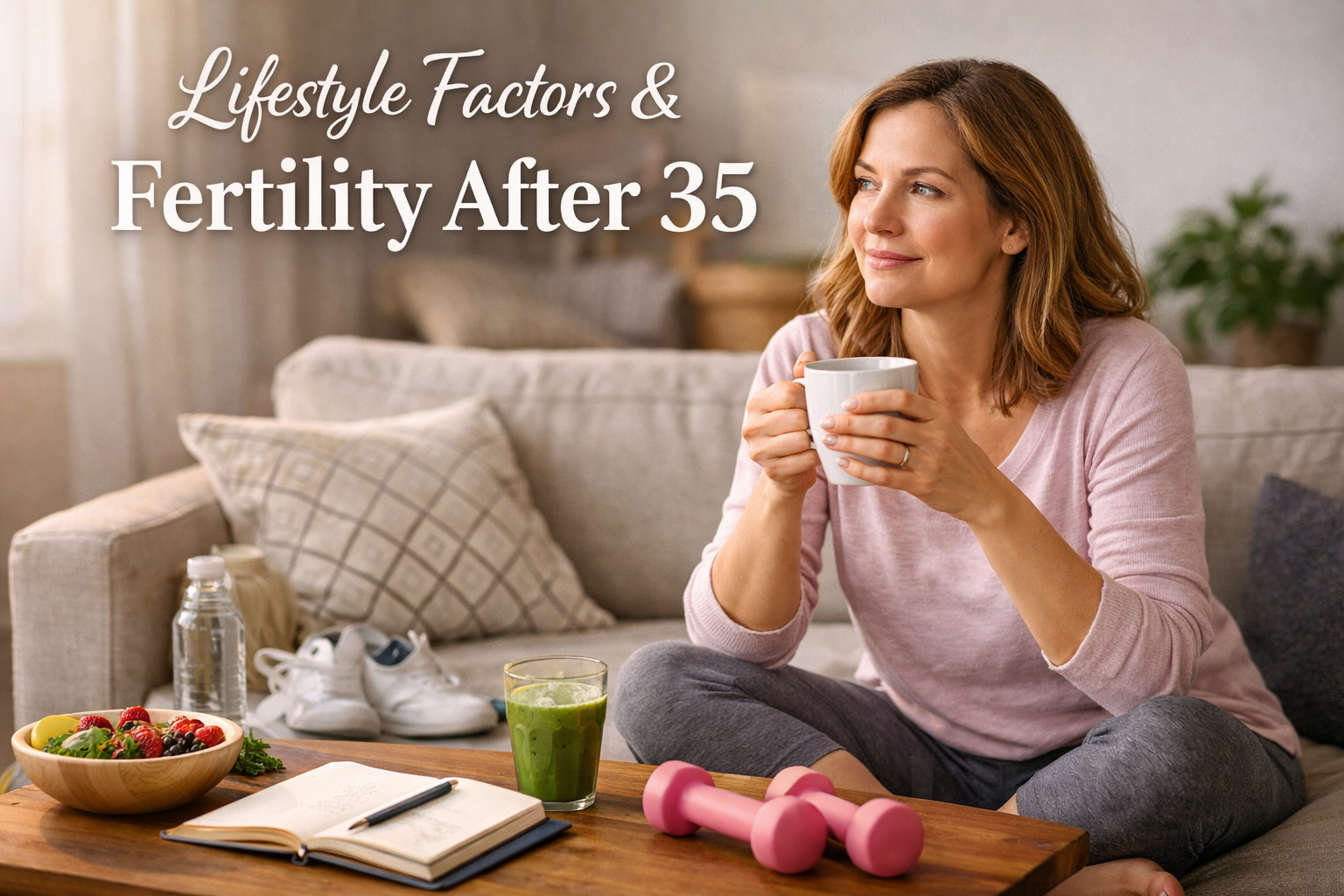
Among the factors affecting fertility in women over 35, lifestyle variables are both the most frequently discussed and the most frequently misrepresented. Some have meaningful evidence behind them; others are overstated. None override age-related biological changes, but they are not irrelevant either.
Smoking
Smoking has among the strongest evidence of any lifestyle factor for a negative effect on female fertility. Research consistently links smoking with earlier menopause onset (by approximately 1–4 years), reduced ovarian reserve markers, and lower conception rates. The mechanisms are thought to involve direct toxic effects on ovarian follicles. Smoking cessation is consistently recommended by fertility specialists, and benefits appear to accrue regardless of when cessation occurs.
Body Weight
Both significant underweight and overweight are associated with disruptions to ovulatory function and hormonal regulation. Adipose tissue is metabolically active and involved in estrogen metabolism — excess fat can elevate estrogen levels and disrupt the hormonal feedback that regulates ovulation, while very low body fat can suppress hypothalamic-pituitary signalling. BMI is an imperfect measure of health, and the relationship between weight and fertility is not linear. Individual assessment with a healthcare provider is more useful than applying population averages to personal situations.
Nutrition and Dietary Patterns
The research on diet and fertility supports some general patterns without endorsing specific prescriptions. A 2018 review published by the National Institutes of Health found that dietary patterns characterised by higher intakes of vegetables, whole grains, legumes, and fish — and lower intakes of processed foods and trans fats — were associated with better fertility outcomes on average. Specific preconception nutrients with clearer evidence include folate, iron (in deficient individuals), and iodine. Nutritional research in fertility is prone to confounding, and individual nutritional needs are best assessed with a provider.
Physical Activity
Moderate regular physical activity is generally associated with positive outcomes for reproductive health, including improved insulin sensitivity and hormonal regulation. Very high-intensity exercise combined with caloric restriction can suppress reproductive function through hypothalamic effects. For most women, regular moderate activity supports rather than hinders fertility. Women engaged in intensive athletic training with concerns about menstrual regularity are advised to discuss this with their healthcare provider.
Alcohol and Caffeine
Heavy alcohol consumption is associated with menstrual irregularities and reduced fertility; the picture for light-to-moderate intake is less clear. Most fertility guidelines recommend limiting or avoiding alcohol during preconception as a precautionary measure. Caffeine research shows mixed findings: high intake (above 200–300mg per day) has been associated in some studies with modest increases in time to conception. ACOG guidelines recommend staying below 200mg per day during preconception and pregnancy.
Sleep Quality
Emerging research suggests that sleep disruption may affect reproductive hormones including FSH and LH. For women over 35, where hormonal regulation is already subject to age-related changes, consistently poor sleep may compound these shifts. The evidence is not yet definitive enough to establish direct links between sleep quality and conception rates, but the hormonal pathways are biologically plausible. Our overview of female sleep after 35 covers this research in more depth.
Psychological Stress
Chronic stress can influence the hypothalamic-pituitary-ovarian axis, affecting cycle regularity in some women. The relationship between stress and fertility is real but frequently overstated — and the framing that “stress causes infertility” can itself become a source of additional pressure. Stress management practices are worthwhile for overall wellbeing; approaching them primarily as fertility interventions adds an unhelpful layer of pressure to an already challenging situation.
Environmental Factors
Certain environmental chemicals — particularly endocrine-disrupting compounds found in some plastics, pesticides, and personal care products — have been associated with adverse effects on ovarian function in observational research. Phthalates and bisphenol A (BPA) have received the most research attention. For women over 35 with already-declining ovarian reserve, minimising unnecessary exposure to known endocrine disruptors is a reasonable precautionary step, though individual impact is difficult to quantify and the evidence continues to evolve.
When to Seek a Fertility Evaluation
ACOG guidelines recommend that women over 35 who have been trying to conceive for six months without success seek evaluation — compared to the one-year threshold recommended for women under 35. Women over 40 are generally advised to seek evaluation sooner. A fertility evaluation typically includes hormonal assessment (AMH, FSH, LH, estradiol, thyroid function), a uterine and ovarian ultrasound, and assessment of tubal patency. Partner evaluation is also a standard component, given that male factors contribute to approximately 40–50% of fertility challenges across all age groups.
Early evaluation doesn’t presuppose that there is a problem — it simply provides more information, sooner, at an age when time is a relevant variable.
Frequently Asked Questions
What are the main factors affecting fertility in women over 35?
The main factors include age-related changes to egg quantity and quality, ovarian reserve levels, hormonal shifts (particularly FSH and progesterone), medical conditions such as thyroid dysfunction, endometriosis, and uterine fibroids, and lifestyle factors including smoking, body weight, nutrition, and sleep. These factors interact differently in each individual, which is why personalised evaluation with a healthcare provider is the most useful approach.
Can lifestyle changes significantly improve fertility after 35?
Lifestyle factors can support the reproductive environment, but they cannot reverse age-related biological changes to egg quality and quantity. Smoking cessation and maintaining a healthy body weight have the strongest evidence for positive impact. Thinking of lifestyle as “optimising conditions” rather than “overcoming biology” is a more accurate and less pressure-inducing frame. Any lifestyle changes relevant to your situation are best discussed with a healthcare provider who knows your individual picture.
Does stress affect fertility in women over 35?
Chronic psychological stress can influence the hormonal pathways that regulate ovulation, and research does show associations between stress markers and aspects of cycle function. However, the evidence doesn’t support the idea that stress directly causes infertility in most cases. Managing stress is valuable for overall health and wellbeing — but it’s important not to compound an already stressful situation by treating stress reduction itself as a fertility obligation.
How long should women over 35 try before seeking fertility help?
ACOG guidelines recommend seeking a fertility evaluation after six months of trying to conceive without success for women over 35 — compared to one year for women under 35. Women over 40 are generally advised to seek evaluation earlier still. Evaluation doesn’t imply there is a serious problem; it provides information at a stage when acting on that information sooner is more useful.
What medical conditions are most likely to affect fertility after 35?
Thyroid dysfunction, endometriosis, uterine fibroids, and polycystic ovary syndrome (PCOS) are among the medical conditions most commonly associated with fertility challenges in women over 35. Some of these may have been present for years but become more relevant when actively trying to conceive. A thorough fertility evaluation screens for these and other underlying factors that may be contributing to difficulties.
Key Takeaways
- Age is the most significant factor affecting fertility after 35, influencing both egg quantity and quality — though many women conceive naturally in their late 30s and early 40s
- Medical conditions including thyroid dysfunction, endometriosis, and uterine fibroids can compound age-related fertility changes and are worth evaluating
- Lifestyle factors — particularly smoking cessation and body weight — have meaningful evidence for their relevance to fertility, though none override biology
- ACOG guidelines recommend seeking fertility evaluation after six months of trying to conceive without success for women over 35
- Individual factors vary considerably — personalised assessment with a healthcare provider is more useful than applying population-level statistics to your own situation
This content is for informational purposes only and does not constitute medical advice. Individual health situations vary significantly. Always consult a qualified healthcare provider before making decisions related to your health, fertility, or pregnancy.
About the Author
Emily Carter is a women’s health writer focused on fertility, pregnancy after 35, and sleep changes in midlife. She writes research-informed, non-alarmist content to help women navigate reproductive and hormonal transitions with clarity and confidence.